Aerial Lift Safety for Field Technicians: A Practical Guide to Working at Height

Working at height during overhead electrical, lighting, and facility work.
Aerial lifts help field technicians reach work areas that would otherwise be difficult or unsafe to access. On commercial and industrial sites, those jobs may include overhead lighting and electrical maintenance, low voltage cabling, cable tray and conduit runs, access points and camera mounting, signage, racking, and inspections at height.
A safe lift assignment starts before anyone raises the platform. The machine must fit the work, the site must be assessed, and operators and nearby crews must understand the plan. This guide provides practical planning points for businesses, project managers, facility teams, and technicians. It is not legal advice or a substitute for the lift manufacturer’s manual, site procedures, or qualified safety guidance.
1. Match the lift to the task
Aerial lifts are not interchangeable. Select equipment based on the work position, reach, floor and ground conditions, access path, and load. Use the specific machine according to its operating manual.
- Scissor lifts: Often suited to straight-up work on firm, level floors, such as installing lights or running cable over an aisle.
- Single-person lifts: Compact options for certain one-worker tasks and restricted indoor spaces. Confirm that the platform, height, capacity, and access route fit the job.
- Towable lifts: May be useful when a job requires a lift that can be moved between locations by a towing vehicle. Confirm setup space, ground conditions, and the machine’s limits.
- Articulated boom lifts: The jointed boom can help technicians reach up and over obstacles or around structures.
- Telescopic boom lifts: The extending boom may suit work requiring longer horizontal reach.
The right choice is not simply the machine with the greatest height. A lift with unsuitable access dimensions, floor requirements, platform capacity, or reach can add risk and delay. If the lift is rented or supplied by another party, verify its type and model before work begins.

An aerial lift staged beside an active work area during a deployment. Coordinate the equipment, work zone, and other crews before starting.
2. Survey the site before dispatch
A site survey helps the project team identify equipment needs and conditions that could affect safe access. Record the details before scheduling on-site support:
- Floor condition, slope, surface, floor openings, and nearby drop-offs.
- Ceiling height, overhead clearance, beams, lights, sprinklers, and other obstructions.
- Power lines and other electrical hazards.
- Entry routes, doorway widths, aisles, ramps, loading docks, and turning space.
- Ground-bearing capacity and the equipment’s requirements for tires, outriggers, or stabilizers.
- Pedestrian traffic, vehicle routes, active operations, and adjacent work.
- Whether a spotter is needed to guide the lift or help control the work area.
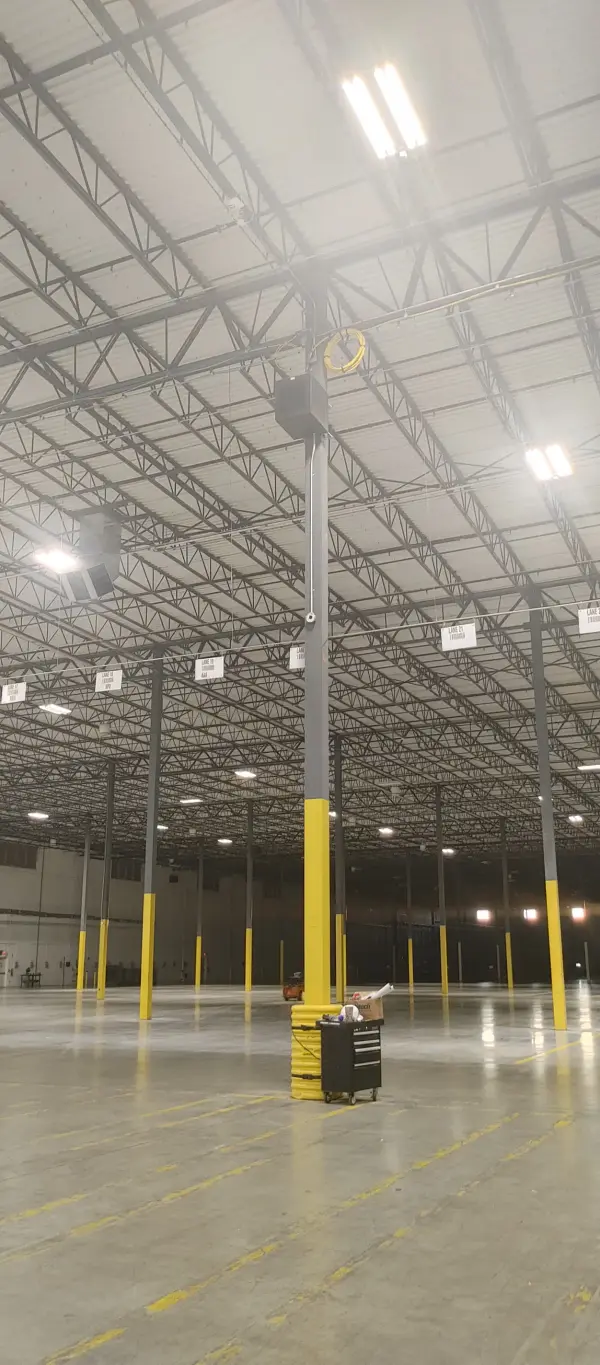
Ceiling height, column spacing, and floor condition all shape the lift plan. Document them during the survey.
In retail or warehouse environments, a route that appears open during a walkthrough may be blocked during business hours by stock, carts, forklifts, or deliveries. Check the planned work window and arrange barriers or access controls before the lift arrives.

High-mounted network equipment and cable runs can require planned lift access. Confirm the installation location and overhead clearance in advance.
3. Complete a pre-use check
Before operating the lift, conduct a walk-around and follow the inspection steps for that specific model. A typical pre-use check includes:
- Platform, structural components, guardrails, gate, and chains.
- Tires, wheels, brakes, and visible damage.
- Controls, emergency stop, alarms, and warning devices.
- Emergency lowering controls and descent system.
- Hydraulic hoses and visible leaks.
- Battery or fuel condition.
- Warning decals, capacity information, and load charts.
- Inspection and service records, including confirmation that the machine has current annual inspection and service documentation.
Test functions only as directed in the operator’s manual. If a safety-critical component is damaged, missing, or not working correctly, do not use the lift. Report it and keep the equipment out of service until it has been addressed by an appropriate qualified person. Do not bypass alarms, interlocks, or other safety devices.
4. Confirm operator readiness and fall protection
Operators should be trained and authorized for the type or class of equipment they will use. They should know the machine’s controls, capacity, operating limits, and emergency procedures, and be familiar with the manufacturer’s manual. A person who is not physically or medically fit to work at height, or who is under the influence of alcohol, drugs, or impairing medication, should not operate the lift.
Fall protection depends on the equipment and work conditions. In a boom lift, workers generally use the harness and lanyard system specified for the machine and task, connected only to a manufacturer-designated platform anchor point. Do not attach to nearby structures or improvise an anchorage.
On scissor lifts, complete, properly maintained guardrails are an important part of the platform’s protection. Follow the machine manual and site requirements for any additional personal fall protection. For all lifts, keep the gate closed and stay inside the platform. Never climb or sit on railings, or use a ladder, plank, box, or other improvised platform to gain height.
For background, review the OSHA aerial lift safety resource and scissor lift safety resource. These references do not replace the equipment manual or a site-specific safety plan.
5. Operate within the lift’s limits
Before raising the platform, confirm that the work area is clear and that the combined weight of workers, tools, and materials remains within the rated capacity. During the job:
- Keep both feet on the platform floor.
- Keep tools and materials secured and within the platform.
- Do not exceed rated capacity or use the lift as a crane or material hoist.
- Do not move the lift with workers elevated unless that machine is designed and rated for elevated travel.
- Lower the platform before traveling when the manual requires it.
- Keep clear of energized lines. Identify applicable approach distances and controls before work starts; do not assume one distance applies to every site or electrical condition.
- Shut down the lift before leaving the platform.
Use a spotter where visibility, obstacles, traffic, or overhead hazards call for one. Keep pedestrians and other trades away from the machine’s path and the drop zone. Coordinate with crews working overhead so no one is exposed to falling tools or materials.
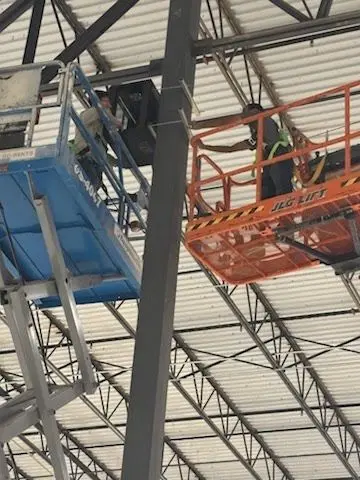
Multiple lifts working in the same overhead area. Define work zones and spotters before crews raise their platforms.
6. Check weather, surroundings, and emergency plans
For outdoor work, follow the lift manufacturer’s wind limits. Consider gusts as well as steady wind, and stop work if weather or conditions exceed the machine’s limits. Lightning, storms, rain, and extreme heat can also affect the work plan. Provide access to drinking water and breaks when heat conditions require them.
Pay special attention to loading docks, open edges, unstable surfaces, battery charging locations, and fueling areas. Keep the equipment away from hazards unless the site plan and manufacturer instructions specifically address them.
Before work begins, identify how the platform can be lowered if normal controls fail or the operator cannot act. Confirm where ground controls and the emergency descent system are located, who can use them, and how workers will communicate. Make sure the crew has a rescue plan, a headcount process, and a way to request emergency assistance. Use the machine’s approved procedures; do not improvise a descent or attempt an unplanned rescue.
7. Plan the assignment with your dispatch partner
Overhead work often connects to larger projects: installations, upgrades, maintenance, low voltage cabling, networks, access points, server equipment, point of sales systems, commercial inspections, retail audits, and retail merchandising services. The lift is one piece of the plan. The dispatch partner and site contact should also confirm equipment access, work windows, reporting needs, and coordination with other trades.
A field service technician or managed service provider supporting the project should document site conditions and raise concerns before work proceeds. A responsible provider will stop and request review when conditions are unsafe or when the actual site differs from the assignment information.
Texarkana2Go supports field assignments across an approximately 120-mile service call radius from Texarkana USA, including Shreveport/Bossier City LA, Little Rock AR, Nashville AR, Idabel/Broken Bow OK, Mt. Pleasant TX, Atlanta TX, and Longview TX. Travel fees may apply outside the free 25-mile zone. Availability depends on the assignment, location, schedule, and required qualifications. On-demand staffing and temporary staffing services can support deployments when project needs and technician qualifications align.
For service details, visit Field Services.
Request an aerial lift assignment
Submit a dispatch request with:
- Site list and addresses.
- Scope of work.
- Ceiling height and work locations.
- Access routes, doorway widths, and known site restrictions.
- Available power and relevant electrical conditions.
- Schedule windows and occupancy requirements.
- Lift type or equipment needs, if known.
- Reporting, photo, or inspection requirements.
Complete details help the dispatch team assess location, staffing, equipment, and scheduling needs before the project is assigned.